Kenya
The programme worked directly with survivors of SGBV committed during the 2007–2008 post-election violence.
At a glance
|
Status |
Completed in June 2025 |
|
Programme period |
April 2023 – June 2025 |
|
Where |
Nakuru, Nairobi, Meru, Mombasa, and Western Kenya |
|
Who it serves |
Survivors of sexual and gender-based violence from the 2007–2008 post-election violence, and their households |
|
People reached |
208 survivors (182 female, 26 male) and their households |
|
|
|
Background
The assistance programme addressed harm suffered by survivors of sexual and gender-based violence (SGBV) arising from the 2007–2008 post-election violence in Kenya.
For more information on Kenya and the ICC, visit ICC Page.
The programme
The TFV launched a two-year programme for victims in the situation in Kenya in April 2023. It alleviated the harm suffered by survivors of sexual and gender base violence in the post-election violence of 2007 and 2008 and their families through integrated medical, psychological, and socio-economic rehabilitation, applying a trauma-informed victim-centred approach to promote recovery, resilience, and long-term empowerment.
Building on the lessons of the first year, the second year was refined to enhance impact and sustainability through a four-pronged strategy:
- delivering holistic rehabilitative services;
- strengthening provider capacity;
- promoting economic empowerment; and
- documenting lessons to inform future policy.
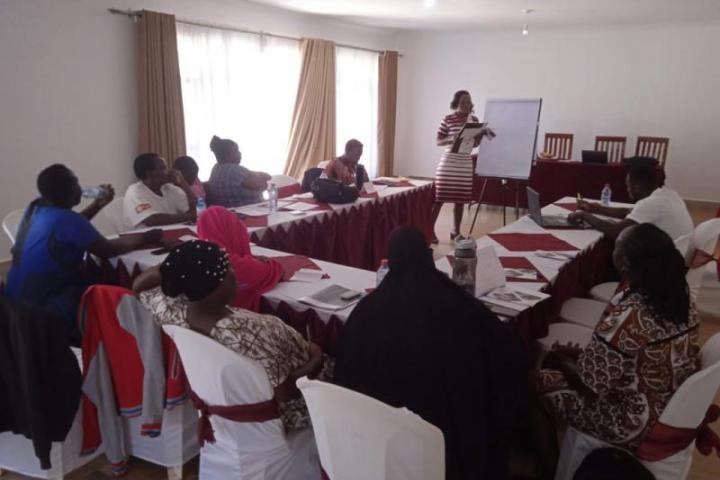
Service delivery was successfully completed in June 2025. A closing workshop held in Nairobi in April 2025 marked the rehabilitation achievements and activities of the project ensuring a smooth transition, proper handover, and the preservation of programme knowledge.
Who was the programme for
People the programme worked directly with:
- Survivors of SGBV committed during the 2007–2008 post-election violence.
People who benefit more widely:
- Survivors’ households and families;
- Communities were also engaged through outreach and awareness-raising initiatives.
What the programme delivered
All beneficiaries received a consistent package of rehabilitative measures:
- Progressive counselling sessions and psychological support
- Medical treatment and physiotherapy
- Training in socio-economic empowerment, including vocational training
Results: In its first year, the programme supported 100 SGBV victims. The second year enrolled a further 108, bringing the total to 208. By the end of the programme, all 208 (182 female and 26 male) had received medical and psychological support, and 95 (88 female and 7 male) had completed vocational training.
Outreach: The TFV met with civil society organisations and human rights networks to forge synergies and to address victim expectations and perceptions of the TFV and the ICC. Informational materials were developed and disseminated, and radio talk shows on two major stations in different regions raised awareness of the programme’s objectives, eligibility criteria, and services.
Funding
Since 2004, 53 States Parties have contributed at least once to the TFV, for a total of EUR 56 million. Because of the nature of its interventions, contributions to the TFV are ODA-eligible and may be earmarked to a specific country, type of victim, or type of activity.
The programme is designed and managed by the Secretariat of the TFV under the supervision of the Board of Directors. The Secretariat is funded from the regular contributions of States Parties, so there is no overhead on the programme and resources go entirely to victims.